Saturday, 17 June 2017

China Rockfish

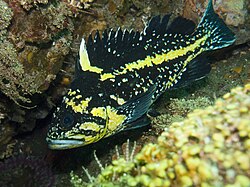
China rockfish (Sebastes nebulosus)


Watch out for my spines!!

China rockfish in Neah Bay August 2009 JLL.jpg
China rockfish prefer waters along the outer coast and at the western end of the Salish Sea and are known as very territorial cave dwellers. They grow up to 45 cm in length, and are very attractive fish with a dark blue to black body covered with yellow freckles and a distinctive yellow stripe that travels from their third dorsel fin to the tail. Its bright colours are most likely a warning to predators to stay away because this rockfish has venomous spines. The dorsal fin has long spines to ward off enemies, and if threatened, the rockfish will extend these spines to make itself appear larger than life! The dorsel fin is also used to help the fish maneuver into tight crevices and caves by allowing it to anchor or brace against the cave walls or roof. China Rockfish are generally solitary hunters and use their superpower ability to squirm into tight crevices to capture brittle stars, crustaceans, squid, and shrimp. Adult china rockfish prefer to hang out in the numerous crevices provided by rocky outcrops, and they are very territorial, only venturing out to about a 10 m from home. Perhaps because they do not stray far from home and can squeeze into tiny hiding spots, they can live to about 80 years old!

 http://wdfw.wa.gov/fishing/bottomfish/identification/rockfish/s_nebulosus.html
https://en.wikipedia.org/wiki/China_rockfish
http://aquarium.org/animals/china-rockfish/

Harbour Seal

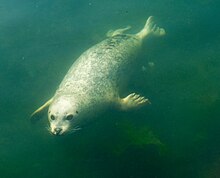
Harbour seal (Phoca vitulina richardsi)


If you have visited Fisherman’s Wharf or the Oak Bay Marina, chances are you will have seen a harbour seal or even fed one of them a nice, tasty fish (if the seagulls did not rudely snatch it out of your hands). Seals can be found at all of Victoria’s harbours, usually lounging like its Super Bowl Sunday on rocky reefs, sandbars and boulders. The local species is called the Pacific harbour seal and it belongs to a group of mammals called the pinnipeds which means fin or flipper-footed and which also includes sea lions and walruses.
Image result
Harbour seals live in temperate to arctic waters along the coastline of the north Pacific and Atlantic Oceans and tend to remain in the same general area their entire life, usually within a 25 km distance from shore. Harbour seals scatter into small groups during mating season in the early spring to mate underwater, and then give birth in July to August to a single live pup on land. These cute pups weigh around 22 pounds and can crawl and swim within hours of birth (probably to outswim those hungry orcas). Male seals can live up to 20-25 years, and female seals up to 30-35 years. Harbour seals have a thick layer of fat to keep them toasty in the chilly waters.

You can tell seals apart from sea lions because they do not have external ear flaps, they have shorter fur-covered front flippers, they cannot raise their heads or shoulders on land, they move like an inch-worm on land, and in the water they scull with their back flippers and steer with their front flippers making them very agile swimmers. Sea lions, on the other hand, are much more agile on land because they can raise their head and “walk” on both pair of flippers (this is probably why sea lions get all of the marine show gigs). Harbour seals are about 1.2 to 1.6 m in length and weigh approximately 130 to 180 pounds, although some larger adults can grow over 1.8 m and weigh up to 290 pounds!  The colour of their fur can be black, brown,tan,gray or silvery white, with a unique pattern of light or dark spots.
Harbour seals eat fish such as sculpins, small flatfishes and rockfishes, greenlings, smelts, perches, hake, herring and salmon. They are also known to eat crustaceans (crayfish, crab, shrimp), molluscs (ostopus and squid), and even ducks! In the Salish Sea, they often feed on a deep-sea fish called hake (which is probably great with Shake and Bake). When looking for food, seals will usually make quick dives of three to seven minutes to depths less than 100m, although, they can remain submerged for up to forty minutes and dive over 400m deep.
 
Between 1913 and 1964, there was a bounty offered on harbour seals because commercial fisherman thought of them as a threat to their fish stocks. After their numbers declined substantially, the bounties were lifted in the early 1970s and their numbers have rebounded from about 10,000 to at least 105,000 today. In the Salish Sea, there are about 13 seals per kilometre of shoreline (compared to only 2.6 for all of BC’s coastline). Even though the Salish Sea contains only 11% of BC’s total coastline, it supports 37% of all of BC’s harbour seals. Harbour seals (and prey that consume seals such as resident orcas) are threatened by pollution such as organchlorines (PCBs, DDT, dioxins), hydrocarbons (oils, gasoline, solvents) and heavy metals. These debilitating chemicals do not break down easily and are absorbed by smaller organisms which eventaully end up in the stomachs of seals and orcas.

http://vancouverisland.com/things-to-do-and-see/wildlife-viewing/harbour-seals/
https://www.crd.bc.ca/education/our-environment/wildlife-plants/marine-species/harbour-seals
Pacific White-Sided Dolphin

Pacific white-sided dolphin (Lagenorhynchus obliquidens)


Pacific white-sided dolphins with distinctive multi-coloured pattern
  pacific-dolphin-wild-jump.jpg
These beautiful creatures stay in the same pod for life
Pacific white-sided dolphins (Lagenorhynchus obliquidens) NOAA.jpg


If you happened to be one of the lucky passengers on a BC ferry travelling between Powell River and Comox this past Christmas morning, you most likely witnessed an incredible sight swimming alongside! A huge pod of several hundred Pacific white-sided dolphins were seen for about five minutes which is very rare because these mysterious creatures usually travel in much smaller pods of around ten to fifteen.  They are known for being playful, social creatures and for approaching boats.

You can watch the video here: http://globalnews.ca/news/3148369/watch-large-pod-of-dolphins-spotted-swimming-along-b-c-ferry-on-christmas-day/.

Approximately 900,000 Pacific white-sided dolphins are found in the cool to temperate waters of the North Pacific Ocean, from Japan to North America and along the coast from Alaska to Baja, Mexico. They tend to travel in the same social group or pod their entire live, normally in numbers of 10-100 but sometimes in the thousands! They stay close to each other and are known to take care of injured or sick pod members. They distinguish each other with a unique name-whistle.
These dolphins have an interesting pattern of white, light gray and dark gray colours. Their chin, stomach and throat are white; their beaked nose, back and dorsal fin are dark gray; and they have light gray patches along their sides and a light gray stripe that goes from above their eye to below their dorsal fin. The oldest recorded female dolphin is 46 and the oldest male is 42. Females give birth to calves after a gestation period of about a year, and then nurse them for eight to ten weeks. In British Columbia, newborn calves which are about one metre long and 33 pounds heavy, are usually spotted in the summer months between June and August.
Pacific white-sided dolphins use their approximately sixty teeth to eat salmon, squid, Pacific sardines, herring, pollock, capelin, rockfish, hake, cod and other small fish. Transient orcas and sharks prey on dolphins. In BC, transient whale pods were known to devise a trick to catch these fast moving creatures by trapping them in a bay where they would surround them, but the smart dolphins figured it out and have not been seen fooled by this manouever since.
In the 1980s, large numbers of these dolphins were killed because of Japanese, Korean and Taiwanese squid drag-net fisheries which were fortunately stopped after a 1982 United Nations resolution. In the late 1990s, there was another significant drop in numbers probably due to salmon fisheries’ use of sonic sound deterrents meant to keep seals and sea lions away. Dolphins are very sensitive to noise pollution and still unfortunately fall victim to Japanese drag nets. The good news is that they are not endangered!

https://www.vanaqua.org/learn/aquafacts/cetaceans/pacific-white-sided-dolphin

https://en.wikipedia.org/wiki/Pacific_white-sided_dolphin

Tubesnout

Tubesnout (Aulorhynchus flavidus)


Male tubesnout displaying his glowing blue snout to attract the ladies

Image result
These pencil-like fish grow to about 18 cm long and have a distinctive slender snout. They can be found across the Pacific northwest from Alaska to California in near-shore shallows to 30 metres. They are often found in large schools just below the tide in rocky crevices, eelgrass beds, and kelp forests where they feast on fish and crab larvae, small shrimp, and zooplankton floating in the water. Females are typically olive green, whereas, males have a bright blue fluorescent patch on their snout and red/orange fins under their body. Breeding males display their glow-in-the-dark blue snout and bright orange pelvic fins to entice the lady fish during Spring courtship and to fend off competing males who venture into their patch of seaweed. Once a male attracts a female, the female will lay small clusters of amber coloured eggs onto the seaweed. The male will build a nest for the eggs by binding together bits of seaweed with a sticky thread he produces, and he will then protect the nest by actively defending it from predators. These seaweed nests are found at depths from 10-20 metres, although some can reach depths of almost 40 metres.

www.aquablog.ca/tag/featured-vanaqua-dot-org/page/136/

https://en.wikipedia.org/wiki/Aulorhynchus

https://static1.squarespace.com/static/56021b47e4b04aa9439c6fcd/t/574e4d2901dbae72b1da8f87/14
64749359064/Speciesyoumightseeduringourexpedition.pdf

Striped Seaperch

Striped seaperch (Embiotoca lateralis)


Brilliant gold and metallic blue stripes make this one pretty perch!
Image result


The striped seaperch is one of the most colourful fish in the Salish Sea! You can recognize this perch by its vivid blue stripes (fifteen or more) that run horizontally along its copper, oval-shaped body that grows to about 35 cm in length. It lives in near-shore shallows to 30 m, and its range is from southern Alaska to northern Mexico. Schools are found in shallow rocky areas, kelp beds, rocky reefs, and also around docks and pilings. In the winter, seaperch tend to favour crevices and deeper waters. Striped seaperch have relatively large mouths so they can eat a varied diet including small crustaceans, snails, marine worms, mussels, and even brittle stars. A cool fact is that when seaperch are born they are smaller (about one inch) but perfect replicas of the adult fish. They are born live, unlike most fish that hatch from eggs, which gives them a head start because they are more developed before facing the big, bad world of ocean predators. These juveniles are born during the summer months when there is lots of kelp growth which helps form a protective canopy to keep them safe from predators.


http://www.centralcoastbiodiversity.org/striped-seaperch-bull-embiotoca-lateralis.html

http://www.seaotter.com/marine/research/embiotoca/lateralis/html/lateralis.jpg.html

https://cdfwmarine.wordpress.com/2016/10/05/creature-feature-striped-seaperch/

Thursday, 15 June 2017

Sea Monkeys

Brine Shrimp (Artemia salina) aka Sea Monkeys

One of my favourite “pets” when I was smaller was a tank full of Sea Monkeys. Little did I know at the time, but they are actually brine shrimp that are used to feed juvenile fish at the Salish Sea aquarium (and other aquariums around the world). 
Related image
The Amazing LIVE Sea Monkeys!!

These tiny shrimp survive by living in high salinity environments (usually over 60%) because predators cannot handle such an extreme environment. The real brine shrimp do not resemble the comic book version of Sea Monkeys with their pot bellies, webbed feet and crowned heads but instead look like prehistoric, skeletal shrimp with 19 segments comprising their body and the last few segments making a tail. Males grow to about 8 – 10 mm, females grow to 10-12 mm, and both are about 4 mm in width. An interesting fact is that adult brine shrimp have three eyes! They start with a median eye located on the centre of their head, and then as an adult, they develop two more compound eyes mounted on flexible stalks. 
 Image result for sea monkeys alive
Adult Brine Shrimp have three eyes!

Adult females ovulate about every 140 hours and under normal conditions their eggs will hatch right away. The coolest thing about these small critters is that if the salinity drops drastically or their water source dries up, the female’s eggs become dormant and will remain in suspended animation for several years until conditions improve! These dormant eggs, called cysts, have a tough brown-coloured chorion coating and they remain metabolically inactive in a state called cryptobiosis, meaning “hidden life.” If the cysts are then placed in salt water they can hatch within a couple of hours! This is why artemia are perfect as a food source for aquariums where dried cysts can be received and kept dry and cool until ready to be used. 

The commercial industry collects cysts from salt lakes and salt flats to be sold to aquariums and research facilities around the world. Only a small number of companies are allowed to harvest eggs every year. They use spotter planes, GPS, and night vision technology to find “slicks” or floating mats of reddish-brown eggs. A boom is used to surround the eggs and then suck them into sacks on the boat, and they are eventually washed, dried, and vacuum-sealed for shipment.
At the Salish Sea aquarium, the cysts are bleached to make the protective chorion coating thinner so that the larvae can hatch without using as much energy while still retaining a lot of the nutritional value of their yolk sacs. At the aquarium, dried cysts are added to a tower of briny/salt water heated to 30 degrees Celsius, and within 24 hours, the first stage of life called nauplii emerge. The nauplii are then transferred to another tower to go through a process called gut loading for another 24 hours of development. During gut loading, they feed on mixtures of fatty acids and amino acids so that they can pass on benefitial nutrition to the next animal up the food chain. Some artemia are also kept to grow to full size (after three weeks) to feed to juvenile fish. 

Who knew brine shrimp could be so versatile? Did you know that in 1998 approximately 400 million cysts were flown to the moon and back for scientific research? Apparently cosmic radiation is not good for them!


http://mentalfloss.com/article/56755/16-amazing-facts-about-sea-monkeys

https://en.wikipedia.org/wiki/Brine_shrimp

Puget Sound King Crab

Puget Sound king crab (Lopholithodes mandtii)
Not to be confused with the Alaska version, the Puget Sound king is one of the largest crabs in the Salish Sea and can grow to 30 cm across its carapace (hard upper shell). This crab is often described as an underwater “mini army tank” because of its thick, chunky exoskeleton which looks like its covered in bony warts and cone-shaped projections. It is also known as a master of disguise because of how its colours blend so well with its surroundings. As a youngster, it starts off with a bright orange shell which makes it easy to spot. As it ages, the orange fades, and bright red, yellow, blue and purple blotches emerge which help it camaflouge with the rocks found in Puget Sound. The easiest way to find the crab in an aquarium is to look for a colourful rock with legs!  

Image result for puget sound king crab right claw molars
Juvenile crabs are brilliant orange

The Puget Sound king crab evolved millions of years ago from the hermit crab and they are commonly described as hermit crabs that no longer carry around their shells. The larval forms are almost identical and the adult crabs share many similarities such as being right-handed. Both have huge, over-sized right claws that are designed to crush food such as large banacles, sea urchins, anemones, and sea stars (apparantly the giant Sunflower star is a favourite). These large right claws have what look like human molars along the top and bottom which are used to crush and grind its prey. The much smaller left claw can close without gaps making it more like a spoon that can be used for scraping rather than crushing.


Image result for puget sound king crab right claw molars
Check out my HUGE right claw complete with teeth

Unlike most crabs of the Pacific Northwest that walk on all four pairs of legs, the Puget Sound king crab only walks on three pairs of legs with the fourth pair hidden in its large carapace. This makes the crab look very lop-sided when it walks. They like to dwell in rocky sub-tidal habitats with strong currents to 140 metres in depth. Divers often find them clinging to vertical walls or perched on top of small ledges. During breeding season in late winter to spring, these crabs can be found in shallower waters. Although they are named after Puget Sound, an inlet found in northwestern Washington State, they can be found from Sitka, Alaska down to Monteray, California.


http://www.vanaqua.org/files/3513/8081/6664/Puget_Sound_king_crab.pdf

http://www.centralcoastbiodiversity.org/puget-sound-king-crab-bull-lopholithodes-mandtii.html

http://www.advanceddivermagazine.com/articles/kingcrab/kingcrab.html